
A Threshold Between Two Worlds
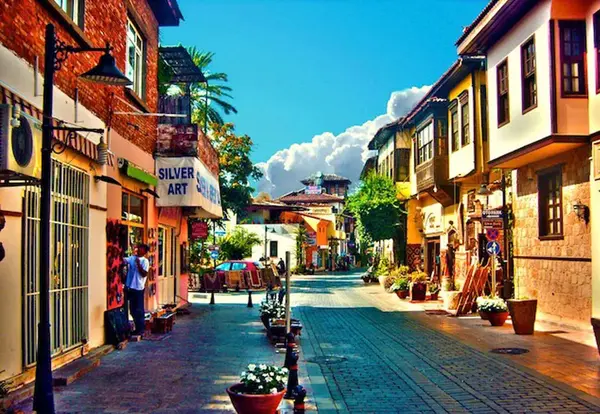
Hadrian's Gate is crossed by thousands of people every day, most of them without pausing. It marks the boundary between modern Antalya and the old city of Kaleiçi — a single step from traffic and shop fronts into narrow cobblestone lanes, red-tiled rooftops, and nearly two millennia of layered history. The gate manages this transition quietly, at every hour, every day of the year.
130 AD: A Gate Built as a Gift
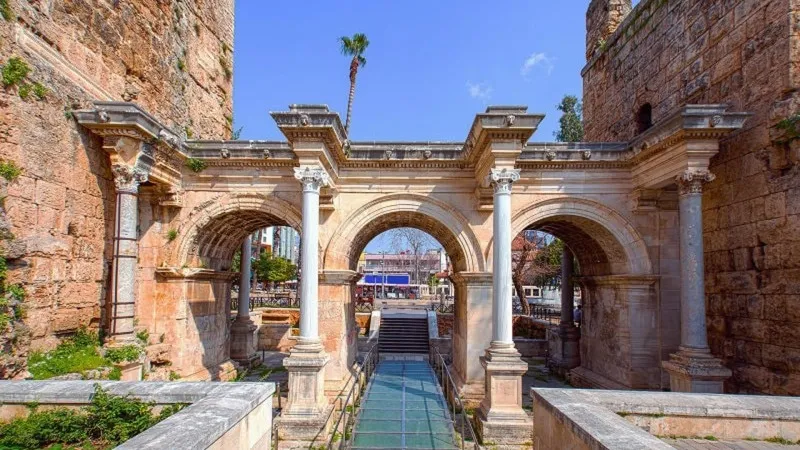
The story of the gate begins in 130 AD, when the Roman Emperor Hadrian visited the city then known as Attaleia. Imperial visits demanded a ceremonial response, and the city delivered one of the most enduring in the ancient world: a triumphal triple-arched gate of white marble, with four Corinthian columns on each facade, and the emperor's name blazing in large bronze letters above the central arch. The gate was not merely an entrance — it was a statement of the city's wealth, loyalty, and ambition.
The structure is built almost entirely of white marble, with the exception of the granite column shafts. Each of the three arches measures 4.15 metres wide and 6.18 metres high. The original gate had a second storey that has not survived.
The Missing Bronze Letters
The emperor's full name — Caesar Traianus Hadrianus — was once displayed above the gate in large bronze letters of the ancient Greek alphabet. Over the centuries the gate was buried under rubble and forgotten, and the letters were discovered scattered in the debris by European travellers in the 19th century, who took them with them. Today nine letters are in Vienna, two are in Berlin, and further letters are held at the British Museum in London and the Ashmolean Museum in Oxford. Only a fragment of the word "Traiano" — Hadrian's inherited name from his adoptive father Emperor Trajan — remains at the site today.
Two Towers, Two Eras
A tower stands on each side of the gate, but they are not from the same period. The southern tower, known as the Julia Sancta, is Roman and was likely built independently of the gate. The northern tower has a Roman base, but its upper section was rebuilt in the early 13th century by Seljuk Sultan Alaeddin Keykubad I and bears an inscription in Arabic script. The two towers together tell the story of Antalya's layered history in miniature — Roman foundations, Seljuk additions, and the long centuries in between.
Rediscovered in 1817
Over the centuries, the city walls gradually enclosed and buried the outer face of the gate until it fell entirely out of use. The Irish hydrographer Francis Beaufort brought it back to the world's attention in 1817, when he anchored HMS Fridericksteen in Antalya harbour and documented the structure. Earlier travellers including Evliya Çelebi had described the city in considerable detail without mentioning the gate at all — testament to how completely it had been buried.
Excavation in 1882 uncovered the lower section fully. The restoration of 1959 removed the makeshift pyramidal stone supports that had replaced the columns and installed white marble Corinthian columns true to the original design. The most recent work, completed in 2021, laid stone paving on the southwest approach toward Kaleiçi and added marble railings along the edges.
A Local Legend
According to an Antalyan tradition, the Queen of Sheba — Sultana Belkis — is said to have passed beneath these gates on her way to visit King Solomon, pausing to spend a happy day in Aspendos. As historians note, she would have lived approximately a thousand years before Hadrian's Gate was built — making the legend chronologically impossible, but no less charming for it.
Practical Information
- Location: Atatürk Caddesi, Muratpaşa. The western entrance to Kaleiçi.
- Getting there: One minute's walk from the Üçkapılar tram station. Served by many bus lines including CV14, KC06, KC34, KL08, and TC16. Walkable from anywhere in Kaleiçi.
- Entrance fee: Free. Open at all hours.
- Time needed: 15 to 20 minutes to explore the gate closely; can be extended into a full day combined with Kaleiçi.
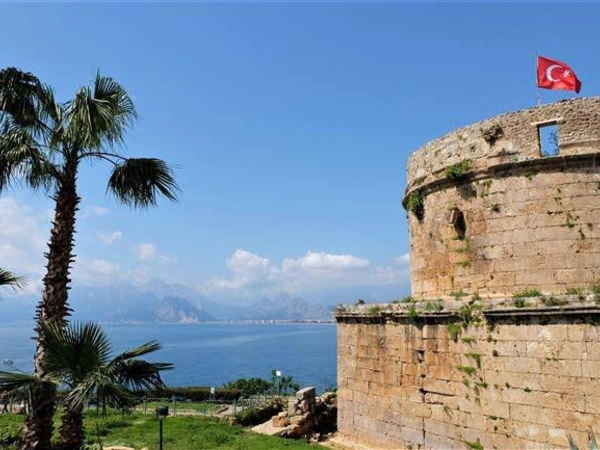
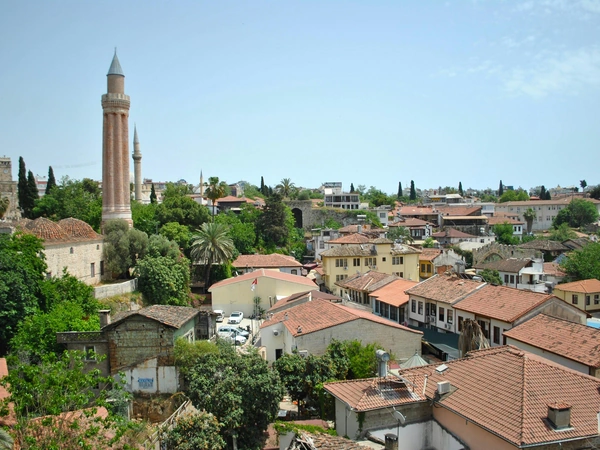
- Combine with: Kaleiçi, the Yivli Minaret, Hıdırlık Tower, and Antalya Museum are all within easy walking distance.