

The Standing Giants of the Taurus Mountains
In the valleys where the Manavgat district meets the Taurus Mountains, rising from among cypress, walnut, and chestnut trees beside the ancient city of Selge, conglomerate rock columns stand between 10 and 70 metres tall. What makes them remarkable is not just their size but their shape: their resemblance to standing human figures is striking enough that the name Adam Kayalar — Man Rocks — was not a conscious invention but a simple description. In recent years they have been compared to Cappadocia's fairy chimneys, to the landscapes of the film Avatar, and to the rock formations of science fiction worlds. None of these comparisons quite captures what they look like in person — which is probably why the site now draws an average of 2,000 visitors per day.
65 Million Years in the Making
The rocks are conglomerate — a sedimentary stone also known locally as "rosy marble" — formed when sand and gravel rising from the sea floor were compressed under pressure and hardened over millions of years. The formations here are approximately 65 million years old. Their surface texture, made up of rounded pebbles of varying sizes locked together with natural cement, gives them both their distinctive appearance and extraordinary structural strength. In antiquity, conglomerate from this region was specifically chosen for use in column construction because of that strength. The rocks also function as natural cisterns: their internal cavities have been used by local villagers as water storage for generations.
The St. Paul Trail
Adam Kayalar lies within Köprülü Canyon National Park, on the route of the St. Paul Trail — the historic path followed by the Apostle Paul during his first missionary journey in 47–48 AD, as he travelled from the Pamphylian coast into the highlands of Pisidia. The trail is today an internationally recognised long-distance walking route, and Adam Kayalar is its most visually spectacular natural waypoint.
The Visit
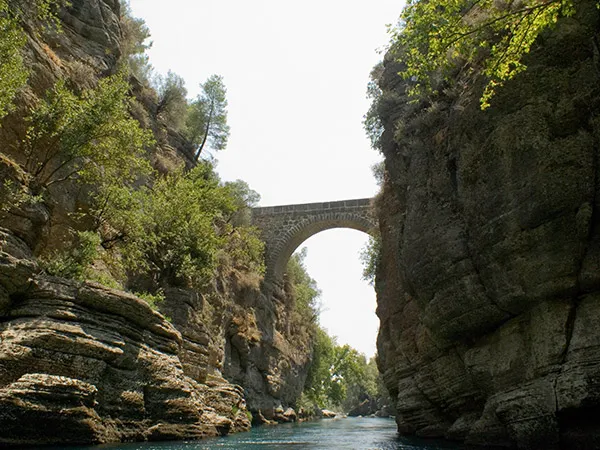
The most popular route begins at Selge Ancient City and follows a forest path for approximately four hours to the rock formations at Ballıbucak district. The route is historically as well as scenically rich: the ruins of ancient Selge, the Roman bridge known as Oluk Köprü, and Tazı Canyon can all be visited on the same day.
The area is at its most visually striking in autumn and early winter, when the surrounding forest turns shades of yellow, green, and red against the pale grey of the rocks. The elevated location — approximately 950 metres above sea level — keeps temperatures noticeably cooler than the coast even in midsummer.
Practical Information
- Location: Ballıbucak Mahallesi, Manavgat, within Köprülü Canyon National Park, near Selge Ancient City. Approximately 114 km from Antalya city centre, 90 km from Manavgat.
- Getting there: Private vehicle or organised tour recommended. The Selge route may require a 4x4 vehicle; the Ballıbucak route is accessible by standard car. Park in the village and continue on foot.
- Entrance fee: Free.
- Time needed: 4 to 5 hours for the full walking route from Selge; 1 to 2 hours to visit the rocks directly from Ballıbucak.
- Important: Water is not available along the route — bring more than you expect to need. Non-slip walking shoes are essential.
- Best time to visit: September–November and February–April. Accessible year-round; the elevated location moderates summer heat.
- Combine with: Selge Ancient City, Tazı Canyon, Oluk Köprü, and Köprülü Canyon make a natural full-day circuit.